


One of my favorite things about the internet is that sometimes the comments are better than the article. You know when a friend sends you an instagram post and says, “Go straight to the comments.”
Two weeks ago, I published Meet All the Middle Aged Women Who Don’t Exist. Since then, it has taken on a life of its own. As I write this, it’s racked up more than 4,700 likes, 871 restacks, 1,700 shares, and over 750 comments.
It quickly became a kind of public service announcement being passed from friend to friend: Be careful. These women may not even exist.
Even medical professionals have started sharing the article. Dr. Heather England proclaimed “every women over 40 needs to read this.” I don't think I could ask for a better compliment.
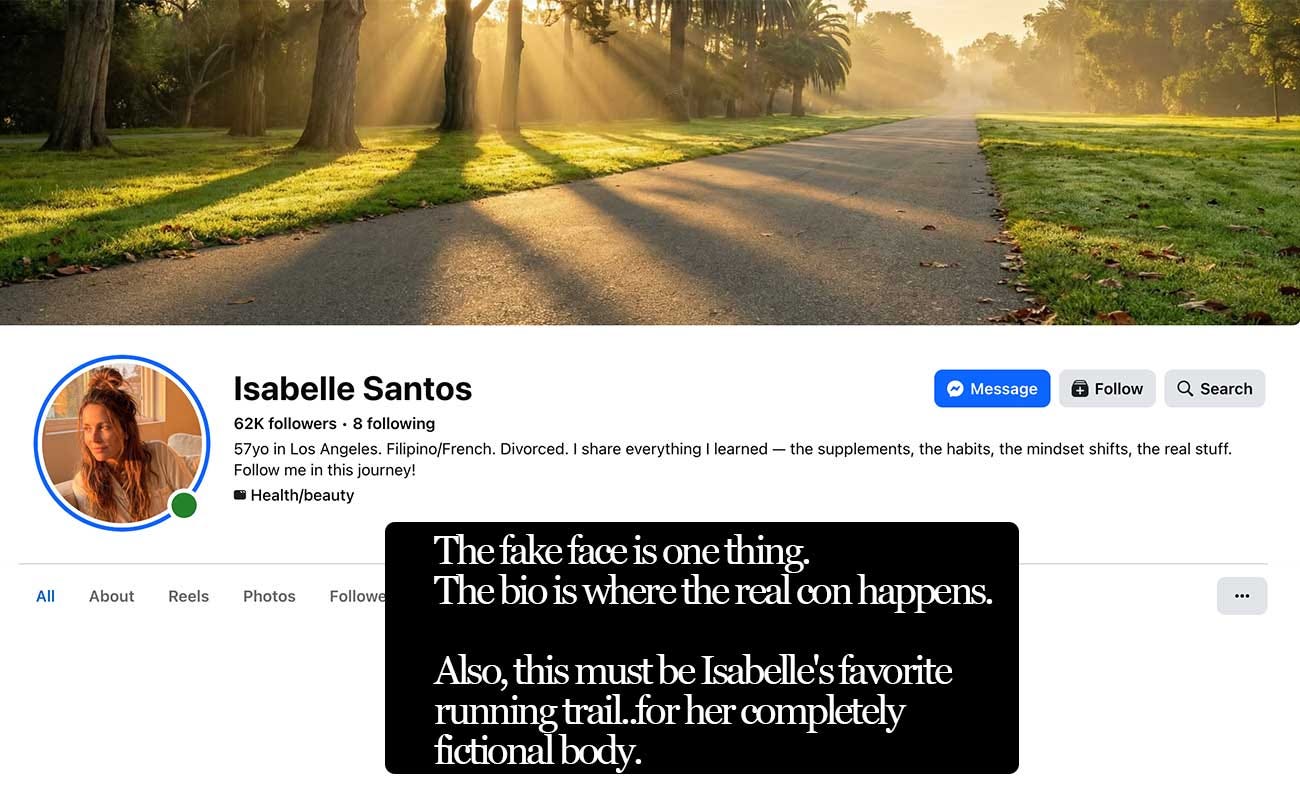
There was one small win, too. “Isabelle Santos,” the AI influencer I highlighted in my article, has been taken down by instagram. Hooray!
Unfortunately she is still alive and well on Facebook where her latest post invites people to comment "REAL" to receive her glow-up guide. The soundtrack? Michael Jackson’s “Human Nature.”
At this point, the joke is writing itself. I couldn't write satire this good.
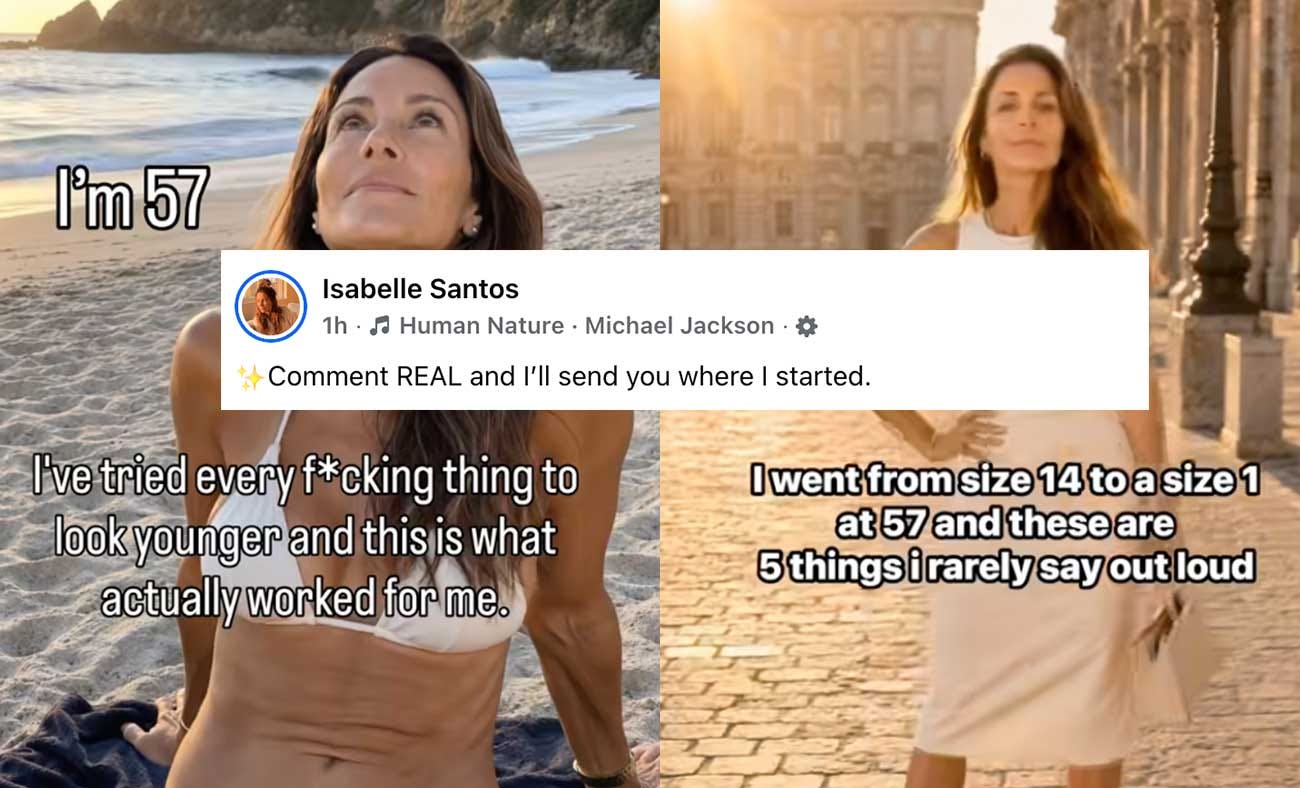
If you come across these AI accounts, keep reporting them. One report won't change much, but thousands might. Once you learn to spot them, you start seeing them everywhere.
I thought I’d just written an article about AI-generated women duping middle aged women into buying supplements. It turns out I'd accidentally started a much bigger conversation. One about authenticity, beauty, trust, AI... and what social media has quietly become.
A few days after my article was published, The New York Times reported on AI-generated supplement scams affecting all ages and sexes. Jia Tolentino also published a brilliant essay in The New Yorker about the increasingly artificial world of beauty, Instagram Face, facelifts, algorithms, and what happens when the face itself starts to separate from the actual person.
The conversation around AI-generated women and the increasingly artificial world of beauty is becoming more fascinating, more complicated, and frankly, very disturbing. What happens when we can no longer tell what's real?
“Wow, this is terrifying. But also, I guess, not surprising”… Rebecca L. Fearnley said.
I did what any Substack writer would do, this past week I spent an embarrassingly long time reading all 700 comments. Somewhere between comment #286 and #493, I realized this article wasn’t really about AI women anymore. I found something much more interesting and I’ll do my best to sum it up here.
It’s not about the artificial women. It’s their artificial life that hurts.
We already accept that magazines are now using AI models and Hollywood has AI actresses like Tilly Norwood scoring roles. We know commercials use actors. We understand that advertising isn’t real life.
One reader defiantly asked: “How is this any different from using actors in a commercial?”
It’s a fair question. But I think the difference is that we all know the person in a TV commercial is playing a role. These AI women aren’t presented as actresses. They’re presented as your friend. Your peer.
That’s a very different kind of persuasion than just a fake beauty image. And judging by the comments...That’s the part that made people the most angry. This is so much more. Someone who’s supposedly lived your life, solved your problem, and is generously “sharing” what worked.
As Sally Oddy wrote,”If we reach a point where we no longer know whether the woman sharing her story is real, whether the photograph is real, whether the recommendation comes from lived experience or a carefully engineered algorithm, something precious is lost.”
Nicole Dieckman Art added, “my biggest fear with the integration of AI. It’s not that we might start trusting the fake things, it’s that we will stop recognizing and trusting the real things.
Confidence scams have always worked the same way. They don’t start by asking for your money. They start by earning your trust. They tell you a story that feels familiar. They make you believe they’re just like you.
Only then do they sell you the miracle. That predatory nature of Isabelle and her friends is what outraged readers the most.
We Miss When Social Media Was Actually Social (And Not One Giant Sales Funnel)
While outrage over the army of AI-generated wellness women dominated the comments, an even bigger frustration emerged: people are simply exhausted by what social media has become. One reader described it as a “simulated reality” where nothing feels real anymore. Many others said they were ready to delete Instagram altogether.
Ironically, today Meta was ordered to pay $942 million after finding the company failed to adequately protect children on its platforms. Children absolutely deserve protection. I’d argue adults need a little protecting too.
To me, social media has just become QVC with better lighting.
What happened to the instagram where people just shared photos of their dog, their holiday, and an occasional blurry meal instead of funneling you into a seven-figure business course... or an Amazon Glow-Up Guide? Lisa Hamil put it simply that she is just “tired of being sold to” at every turn.
There is a general exhaustive feeling that every post, carousel, or reel is trying to sell, sell, sell. A Ritual of Becoming said “marketing has always been a dishonest trade but never so much as today.”
And it isn’t just beauty. It’s wellness. Productivity. Business coaching. Parenting. Dating. Apparently everyone woke up one morning and became an expert in everything. Everyone has a course. Everyone has a secret. Everyone has a link in bio. Social media has become an endless parade of hooks, Canva carousels, AI-generated slop, and sales funnels.
The mental gymnastics required to consume social media is becoming too much. And now we have to worry about AI women. Is this person AI? Is this an affiliate link? Is this person actually qualified? Does she even exist? Is it an AI clone?
People want a real mistake, a real conversation, a real face, a real expert. But it’s becoming nearly impossible to filter through it. Amy Nesbitt detailed a moment watching her friend post every photo with a Snapchat beauty filter. “Every one. The face on her phone barely looked like the woman standing next to me.”
AI Is Pouring Gasoline on the Beauty Wars
If there’s one debate that can reliably start a civil war in the comments section of any beauty article, it’s this one: Should we age naturally? Or should we fight it?
This article on AI women was no exception.
There was a collective relief in the comments of intelligent women discovering they weren’t comparing themselves to real people. While most readers agreed they’d been fooled by Isabelle and her fictional friends, the comments did split into two camps and it gave me a lot to chew on mentally.
One side argued that if we were fooled by Isabelle in the first place, maybe that was the bigger problem. Maybe we’d become so willing to believe in miracle peptides, miracle creams, and miracle supplements that we wanted the fantasy to be true.
A few readers were basically saying: